
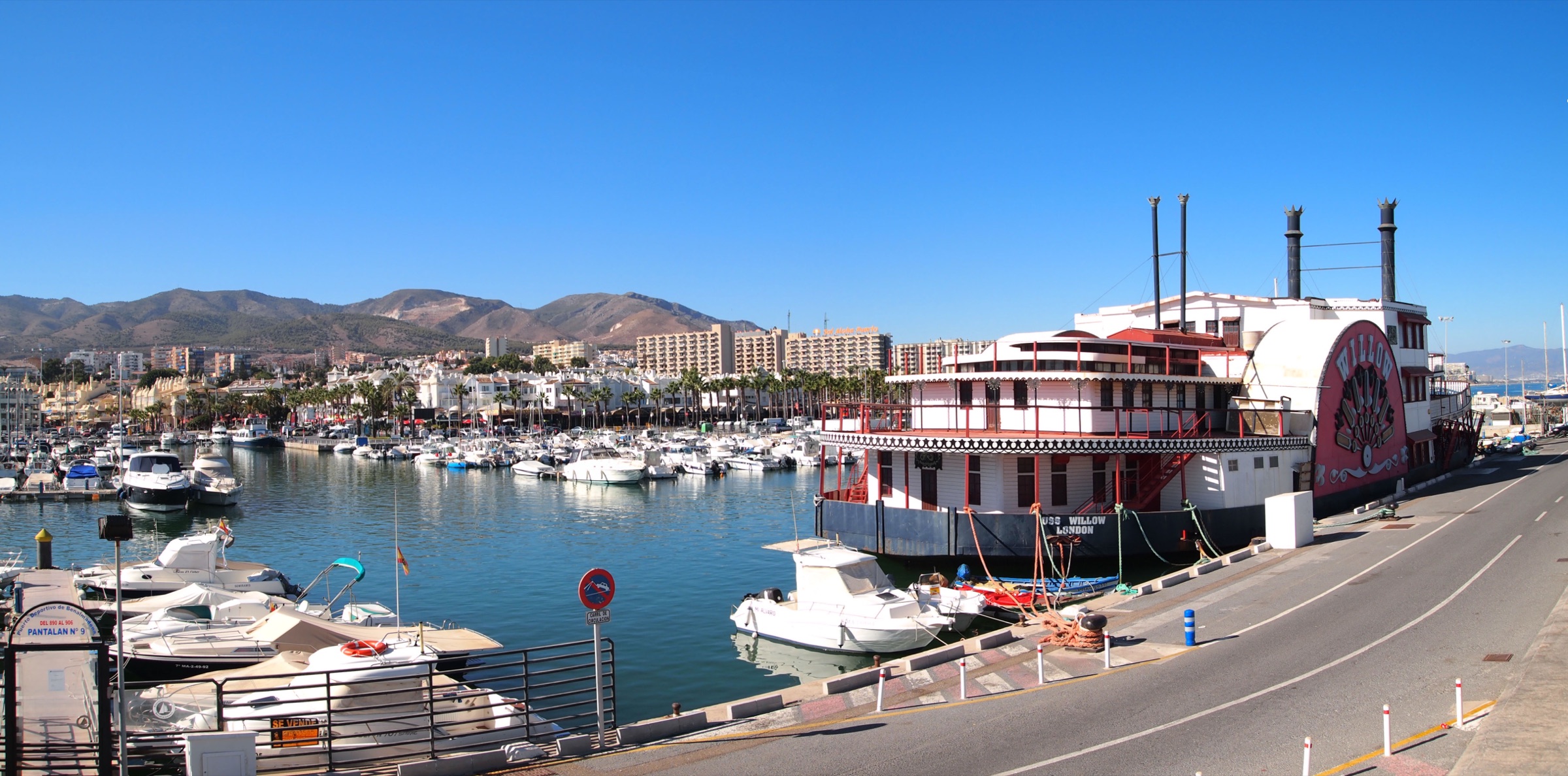
Benalmádena is built on three levels, and each one feels like a separate town. Benalmádena Costa follows the shoreline, Arroyo de la Miel fills the middle ground, and Benalmádena Pueblo, the original village, sits higher up on the slopes of the Sierra de Mijas. A cable car climbs from the lower town to the summit of Calamorro at 771 metres, so the sea and the mountain are rarely out of sight.
The municipality covers 26.87 km² and had 78,338 registered residents on 1 January 2025, according to INE, the Spanish statistics institute. It is a working town with services all year, not only a holiday resort. For most buyers the useful question is which of the three levels fits the way they want to live.
Life in Benalmádena
The name is usually traced to the Arabic Ibn al-ma’din, meaning “sons of the mines”, after the iron and ochre once found in the hills. Three watchtowers survive along the coast: Torre Bermeja, Torre Quebrada and Torre del Muelle. They date from the Nasrid period and were later restored to guard the shore against raids from the sea.
Leisure has shaped the modern town. The Tivoli World amusement park opened in 1973, the Sea Life aquarium followed in 1995, and Selwo Marina keeps dolphins and penguins. There is also a casino. Two monuments are less expected on a Spanish coast: the Buddhist Stupa of Enlightenment, inaugurated in 2003, and Castillo de Colomares, a tribute to Christopher Columbus built between 1987 and 1994. For everyday walks, Parque de la Paloma in Arroyo de la Miel offers 200,000 m² of green space.
The resident population is international. In INE’s household income atlas for 2023, 28.8% of Benalmádena’s residents held a nationality other than Spanish. The average age was 42.2, and households averaged 2.5 people, which points to many couples and people living alone. Local tradition carries on alongside this. Arroyo de la Miel honours its patron saint with the Feria de San Juan, with daytime events in the centre and a night fair at the fairground.
Neighbourhoods
The three centres now run into one another, but each has a different character, and the harbour adds a fourth.
- Benalmádena Costa is the seafront strip, where most of the hotels stand. The municipal tourism office counts nine kilometres of beaches, including Bil-Bil, Santa Ana, Arroyo de la Miel and Fuente de la Salud. Castillo Bil-Bil, a building in Arab style decorated in the Nasrid tradition, stands beside the beach.
- Puerto Marina opened in 1979 under the name Puerto Príncipe and took its current name in 1982. It has 1,108 moorings, with restaurants, hotels, shops and clubs around the quays. Torre Bermeja marks the harbour entrance.
- Arroyo de la Miel grew up around paper mills in the 18th century. Today it is the commercial district between the village and the coast, with the town’s main railway station and Parque de la Paloma.
- Benalmádena Pueblo is the old village, with whitewashed streets, Plaza de España and the church of Santo Domingo de Guzmán. Its viewpoints look along the whole coastline.
Above the houses, the land rises steeply towards Cerro del Castillejo, which at 972 metres is the highest point in the municipality. Because of that slope, the upper parts of town look out over the sea, and the return walk from the beach to the Pueblo is steep and long.
Getting around
The A-7 motorway and the older N-340 coast road both cross the municipality. Málaga–Costa del Sol Airport (AGP) lies about 10 km from the town centre in a straight line, so trips to catch a flight are short.
The Cercanías C1 commuter train is the other main link. It stops at Benalmádena-Arroyo de la Miel station and at a second station further west, towards Fuengirola. Trains run every 20 minutes, east to the airport and central Málaga and west to Fuengirola. The line opened in 1975, and the airport station was moved underground in 2010 when the airport built its second runway.
Benalmádena also has its own urban bus services and belongs to the Málaga metropolitan transport consortium, which runs the interurban bus network. Buses matter here because of the height difference: the Pueblo is well above the coast, and the roads between the levels are steep.
Schools and healthcare
For international families, the British College of Benalmádena was authorised by the Junta de Andalucía in 2002 to teach the British educational system to Spanish and foreign pupils. Admissions, year groups and places should be checked with the school directly.
Benalmádena has both public and private hospitals inside the municipality:
- Hospital de Alta Resolución de Benalmádena: a public hospital of the Andalusian Health Service (SAS) with a 24-hour emergency department.
- Centro de Salud Arroyo de la Miel: the SAS primary care centre for family doctor appointments.
- Hospital Vithas Xanit Internacional: a private hospital with more than 40 medical and surgical specialties, 119 individual rooms and an international patient service that works in 16 languages.
The property market
The latest official figures describe Benalmádena from several angles. Each line gives the source, the period and what is being measured.
- Consejo General del Notariado, homes sold in the latest 12 months published (retrieved August 2026): 1,860 homes sold in Benalmádena at an average of €3,134/m², an average price of €318,161 and an average size of 102 m². On the same basis, Málaga province stands at €3,061/m².
- Ministerio de Vivienda y Agenda Urbana, home transactions based on notarial data, second quarter of 2025 to first quarter of 2026: 1,932 homes sold, of which 161 (8.3%) were new builds.
- Registradores de España, Estadística Registral Inmobiliaria, Málaga province, second quarter of 2026: 8,873 registered home sales at an average of €3,254/m² and €338,816 per home.
- Registradores de España, foreign buyers, fourth quarter of 2025: 12.5% of home purchases in Andalucía and 13.52% in Spain as a whole.
- The NLS, sold prices, third quarter of 2026 to date: a median of €3,135/m² based on only 2 recorded sales. This is a very small sample, and the figure can swing sharply from quarter to quarter.
- The NLS, asking prices on NLS listings at that date, third quarter of 2026: €5,075/m² across 58 listings.
These figures will not match, and that is expected. Notarial deeds, ministry transaction counts, registered sales and asking prices each record a different stage of buying a home, and they cover different periods.
Two points stand out. Benalmádena’s notarial average per square metre is close to the provincial figure, but the typical home sold is smaller, at 102 m² against 120 m² for Málaga province. New builds were a modest part of the market, at roughly one sale in twelve.
Who Benalmádena suits
Benalmádena suits buyers who want town services and a train station close to home without living in a large city. Arroyo de la Miel and the Costa suit people who want the station, shops, beach and health services near one another. Benalmádena Pueblo suits those who prefer a quieter village setting with views and accept a bus ride or drive down to the coast.
Families can combine a British-system school, a public hospital with emergency care and a private international hospital within one municipality. Anyone who enjoys boats will find Puerto Marina’s moorings and waterfront restaurants close by. Buyers who want a large plot, more privacy and lower prices per square metre may find the inland towns of the Guadalhorce valley a better match.
Benalmádena on the map
No homes in this part of the map. Zoom out or move the map.
Homes for sale in Benalmádena
See all 82 homes in Benalmádena
€495,000
Apartment in Benalmádena
RefSt6335NLS ID2305333
Benalmádena, Málaga
- 2beds
- 2baths
- 105m²
Apartment

€630,000
House in Benalmádena
RefSPCRM5014NLS ID2296869
Benalmádena, Málaga
- 2baths
- 106m²
House

€1,095,000
Penthouse in Benalmádena
RefR5322985NLS ID1123372
Benalmádena, Málaga
- 3beds
- 2baths
- 159m²
Penthouse

€420,000
Townhouse in Benalmádena
RefFLP0309NLS ID761403
Benalmádena, Málaga
- 3beds
- 2baths
- 132m²
Townhouse

€979,900
House in Benalmádena
RefCORE1OC-1NLS ID761297
Benalmádena, Málaga
- 3beds
- 2baths
- 137m²
House

€3,500,000
Villa in Benalmádena
RefTA0999NLS ID2328271
Benalmádena, Málaga
- 6beds
- 5baths
- 404m²
Villa
Apartments for sale in Benalmádena

€274,500
Apartment in Benalmádena Costa
RefR5467756NLS ID2318333
Benalmádena Costa, Málaga
- 2beds
- 1baths
- 72m²
Apartment

€210,000
Apartment in Benalmádena Costa
RefR5461513NLS ID2308085
Benalmádena Costa, Málaga
- 1beds
- 2baths
- 42m²
Apartment

€225,000
Apartment in Benalmádena Costa
RefR5447113NLS ID1778004
Benalmádena Costa, Málaga
- 1beds
- 1baths
- 64m²
Apartment

€207,000
Apartment in Benalmádena Costa
RefR5436349NLS ID1728115
Benalmádena Costa, Málaga
- 2beds
- 1baths
- 45m²
Apartment
Houses for sale in Benalmádena

€1,325,000
House in Benalmádena
RefR5021140NLS ID712330
Benalmádena, Málaga
- 5beds
- 4baths
- 301m²
House

€1,475,000
House in Benalmádena
RefR5283751NLS ID690628
Benalmádena, Málaga
- 4beds
- 4baths
- 154m²
House

€850,000
House in Benalmádena
RefR5264443NLS ID719857
Benalmádena, Málaga
- 4beds
- 3baths
- 154m²
House

€675,000
House in Benalmádena
RefR5423305NLS ID1691209
Benalmádena, Málaga
- 4beds
- 3baths
- 232m²
House
Penthouses for sale in Benalmádena

€327,500
Penthouse in Benalmádena Costa
RefR5447116NLS ID1778005
Benalmádena Costa, Málaga
- 2beds
- 2baths
- 80m²
Penthouse

€439,000
Penthouse in Benalmádena Costa
RefR5368999NLS ID1109196
Benalmádena Costa, Málaga
- 3beds
- 2baths
- 145m²
Penthouse

€675,000
Penthouse in Benalmádena Costa
RefR5453842NLS ID2297444
Benalmádena Costa, Málaga
- 3beds
- 2baths
- 113m²
Penthouse

€399,000
Penthouse in Benalmádena
RefR5467786NLS ID2326147
Benalmádena, Málaga
- 2beds
- 2baths
- 87m²
Penthouse
Villas for sale in Benalmádena

€870,000
Villa in Benalmádena
RefST6394NLS ID2311328
Benalmádena, Málaga
- 3beds
- 2baths
- 276m²
Villa

€720,000
Villa in Benalmádena
RefST6393NLS ID2309812
Benalmádena, Málaga
- 6beds
- 3baths
- 329m²
Villa

€636,000
Villa in Benalmádena
RefST6392NLS ID2309811
Benalmádena, Málaga
- 4beds
- 3baths
- 239m²
Villa

€910,000
Villa in Benalmádena
RefST6374NLS ID1768992
Benalmádena, Málaga
- 4beds
- 4baths
- 232m²
Villa
Townhouses for sale in Benalmádena

€695,000
Townhouse in Benalmádena Pueblo
RefR5440588NLS ID1749410
Benalmádena Pueblo, Málaga
- 5beds
- 3baths
- 186m²
Townhouse

€1,340,300
Townhouse in Benalmádena
RefSPCRM5474NLS ID2275991
Benalmádena, Málaga
- 460m²
Townhouse
€420,000
Townhouse in Benalmádena
RefFLP0309NLS ID761403
Benalmádena, Málaga
- 3beds
- 2baths
- 132m²
Townhouse

€590,000
Townhouse in Benalmádena
RefST6382NLS ID2284800
Benalmádena, Málaga
- 4beds
- 3baths
- 140m²
Townhouse
Plots for sale in Benalmádena


New developments in Benalmádena
 Off-plan€430,000 – €1,250,000AbeliasBenalmadenaMiddle Floor Apartment · 2 - 3 beds · 88 - 162 m²
 CompletedFrom €475,000Top ViewsBenalmadenaMiddle Floor Apartment · 3 beds · 124 - 128 m²
 CompletedFrom €524,000NEXUS RESIDENCES – KEY READYBenalmadenaGround Floor Apartment · 3 beds · 164 m²
 Off-plan€680,000 – €810,000Stella 8Benalmadena CostaMiddle Floor Apartment · 3 beds · 130 - 143 m²
Talk to Merike or Margit about Benalmádena
Tell us how you want to live, and Merike or Margit will help you compare the Costa, Arroyo de la Miel and the Pueblo, arrange viewings and explain each step of buying.